
In this topic
What to be able to answer
- Separate Caesar's failed invasion in 55 BC from Claudius's successful one in AD 43.
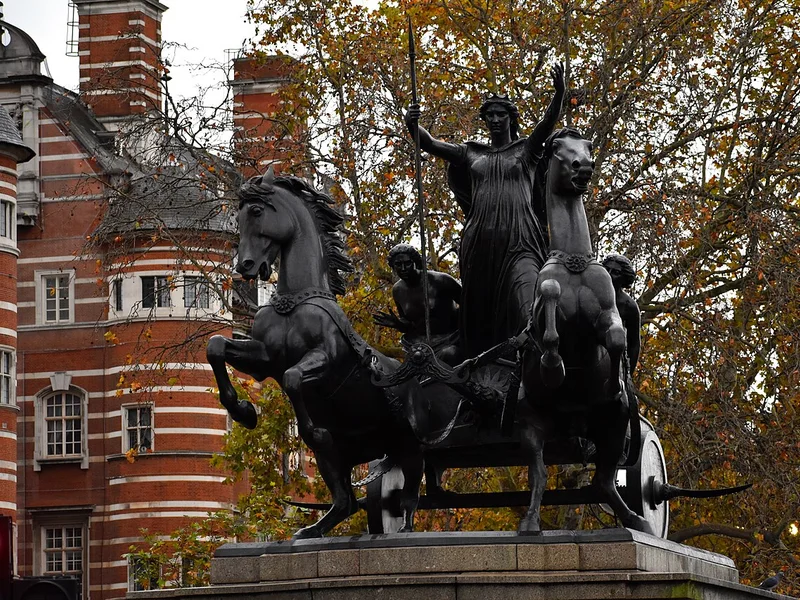
- Know Boudicca: queen of the Iceni, who fought the Romans and whose statue is on Westminster Bridge.
- Know why Hadrian built his wall, what the Romans left behind and when their army left.
Learn
From Caesar's failed invasion to 400 years of Roman rule

Roman Britain, 55 BC to AD 410
Two invasions, one rebel queen, a wall in the north and 400 years of rule.
- 55 BC55 BC
Julius Caesar fails
His invasion was unsuccessful. For nearly 100 years, Britain stayed outside the Roman Empire.
- AD 43AD 43
Emperor Claudius succeeds
Some British tribes resisted, but the Romans occupied almost all of Britain.
- ResistanceResistance
Boudicca, queen of the Iceni
A tribal leader in what is now eastern England who fought against the Romans. Her statue stands on Westminster Bridge in London, near the Houses of Parliament.
- North of EnglandNorth of England
Hadrian's Wall
- Areas of what is now Scotland were never conquered by the Romans.
- Emperor Hadrian built the wall to keep out the Picts, ancestors of the Scottish people.
- Its forts include Housesteads and Vindolanda. It is a UNESCO World Heritage Site, popular with walkers.
- 3rd–4th centuries AD3rd–4th centuries AD
The first Christians
The first Christian communities began to appear in Britain.
- AD 410AD 410
About 400 years of rule end
The Romans built roads and public buildings, created a structure of law and introduced new plants and animals. Their army left to defend other parts of the Empire and never returned.
Roman Britain on the map
A wall across the north, a rebel queen's tribe in the east, and her statue in London.
- 1Housesteads and VindolandaForts on Hadrian's Wall, in the north of England
- 2The IceniBoudicca's tribe, in what is now eastern England
- 3Boudicca's statueWestminster Bridge, London, near the Houses of Parliament
- Hadrian's Wall, built to keep out the Picts to the north
Read the full story (1 min)Optional: the facts above, told in order as one read.
Julius Caesar led a Roman invasion of Britain in 55 BC. This was unsuccessful and for nearly 100 years Britain remained separate from the Roman Empire. In AD 43 the Emperor Claudius led the Roman army in a new invasion. This time, there was resistance from some of the British tribes but the Romans were successful in occupying almost all of Britain.
One of the tribal leaders who fought against the Romans was Boudicca, the queen of the Iceni in what is now eastern England. She is still remembered today and there is a statue of her on Westminster Bridge in London, near the Houses of Parliament.
Areas of what is now Scotland were never conquered by the Romans, and the Emperor Hadrian built a wall in the north of England to keep out the Picts (ancestors of the Scottish people). Included in the wall were a number of forts. Parts of Hadrian’s Wall, including the forts of Housesteads and Vindolanda, can still be seen. It is a popular area for walkers and is a UNESCO World Heritage Site.
The Romans remained in Britain for 400 years. They built roads and public buildings, created a structure of law, and introduced new plants and animals.
It was during the 3rd and 4th centuries AD that the first Christian communities began to appear in Britain.
Do not mix up
Practise
Check this topic
Preparing three random questions from this topic.